

Your business vehicle sale is a tax event first and a cash-in-hand event second. If you don't play it smart, that profit you realise could vanish into a black hole of ATO charges. Understanding the tax implications of selling business vehicles Australia is the only way to protect your bottom line in 2026. It's a massive headache to deal with complex depreciation rules when you just want the asset gone. We know the frustration of unexpected balancing adjustment charges. It's time to take control.
You need a clean break without the financial sting. This guide simplifies the 2026 tax landscape. We cover everything from the $69,883 car limit to GST recapture. We promise to help you master the disposal rules so you can settle your books fast and stay compliant. We'll walk through how to calculate your written-down value, manage the $20,000 instant asset write-off rules, and avoid the common traps that catch local business owners out. Stop stressing over the paperwork. Start planning your next move with total confidence.
Key Takeaways
- Treat your vehicle sale as a tax event rather than a simple cash transaction to stay on the right side of the ATO.
- Understand the tax implications of selling business vehicles Australia to avoid the "balancing adjustment" sting that can turn sale proceeds into taxable income.
- Calculate your vehicle's adjustable value carefully, particularly if you previously claimed a 100% instant asset write-off on the initial purchase.
- Time your disposal and organise your records before you sell to protect your profit and fit within your desired tax bracket.
- Choose a decisive fleet disposal service to settle your books quickly and skip the paperwork headaches of private sales.
Selling a Business Vehicle? The ATO is Watching Your Exit
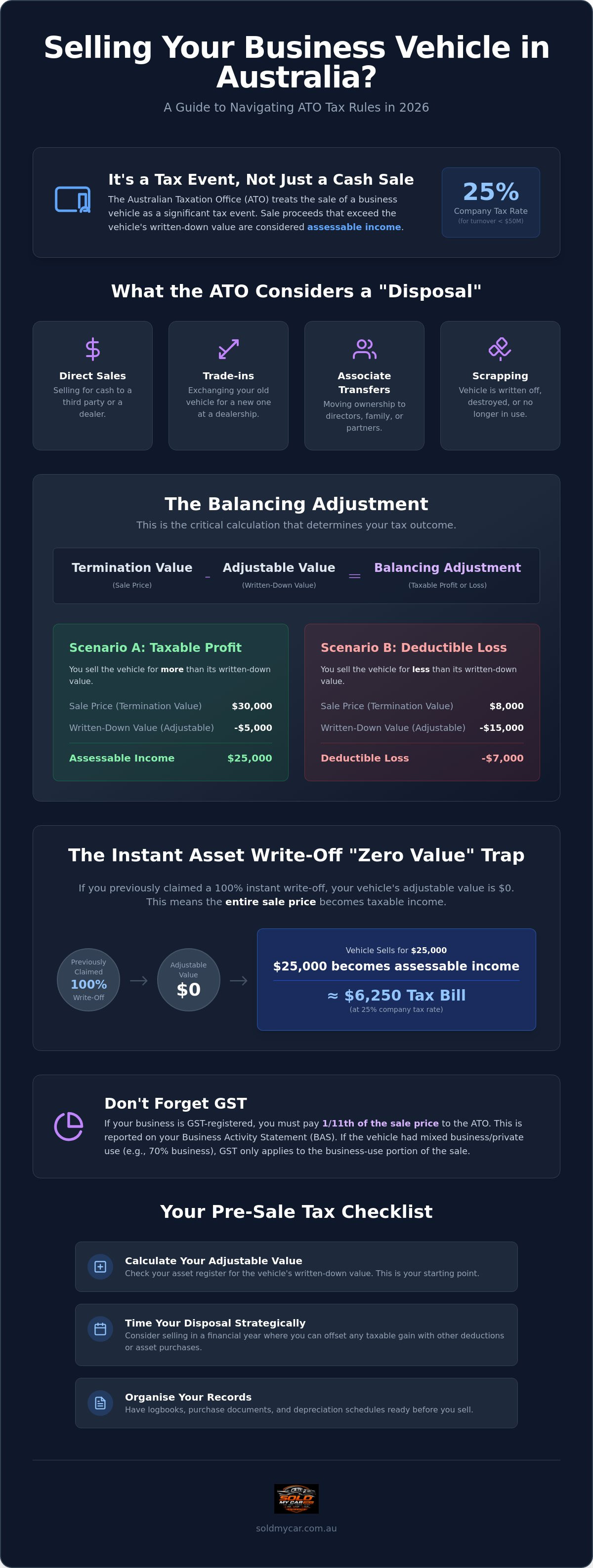
You aren't just selling a used ute on a classifieds site. You're disposing of a depreciable business asset. That distinction changes everything. While a private sale is usually tax-free, a business sale triggers a specific chain of events with the ATO. The tax implications of selling business vehicles Australia are far more complex than a simple handshake deal. In the 2026 tax environment, the ATO views your sale proceeds as assessable income in almost every scenario. If your company turns over less than $50 million, your tax rate sits at 25% for the 2026 financial year. Every dollar you claw back from a sale could be taxed at that rate if it exceeds your vehicle's written-down value. It's a trap for the unprepared. You need to understand that the sale price isn't just cash in the bank; it's a figure that will be scrutinized on your next tax return.
What Counts as a Business Vehicle Disposal?
Disposal isn't always a straightforward sale. The ATO has a broad definition that catches many business owners off guard. You've officially "disposed" of an asset if you do any of the following:
- Direct Sales: Selling to a third party or a professional buyer for cash.
- Trade-ins: Handing over your old keys to a dealership to lower the price of a new model.
- Associate Transfers: Moving ownership to a company director, a family member, or a business partner.
- Scrapping: Removing a vehicle from service because it's no longer roadworthy or is written off.
Each of these actions requires you to calculate the "termination value" of the vehicle. This value is usually the sale price or the market value at the time of the transfer. Don't guess these figures. Accuracy is your best defence against an audit.
The Role of GST in Your Sale
GST adds another layer of paperwork. If your business is GST-registered, you generally have to pay 1/11th of the sale price to the ATO. This requirement stems from the foundational rules of the Goods and Services Tax (Australia). When you bought the car, you likely claimed a GST credit. Now that you're selling, the ATO wants their share of the exit price. You must report this sale on your next Business Activity Statement (BAS). Things get trickier if you used the vehicle for both work and private trips. You only account for GST on the business-use portion. For example, if your logbook shows 70% business use, you only apply the GST rules to that 70%. It's a fiddly process, but getting it right prevents a nasty "balancing adjustment" sting later on. Keep your records straight to ensure your exit is as clean as possible.
The Balancing Adjustment: Why Your Instant Asset Write-Off Has a "Sting"
A Balancing Adjustment is simply the difference between a vehicle’s "termination value" and its "adjustable value" at the time of sale. It sounds like dry accounting, but it's the most critical part of your exit strategy. If you claimed 100% depreciation via the instant asset write-off in previous years, your vehicle's adjustable value is zero. That’s where the trouble starts. Every single dollar of the sale price becomes taxable income for that financial year. You got the tax break on the way in, and now the ATO is clawing it back on the way out. This often leads to an unexpected tax bill if you haven't set aside the funds. Understanding the tax implications of selling business vehicles Australia requires you to look past the cash in your hand and see the liability on your ledger.
Calculating Your Taxable Gain
Start by checking your accounts to determine the written-down value of the vehicle. Compare your sale proceeds, making sure to exclude the GST component, to that book value. This process defines the Disposal of a depreciating asset. If you sell for more than the written-down value, you've made a "taxable profit" that adds to your business income. If you sell for less, you may have a "deductible loss" to claim. It’s a binary outcome. You either owe more or you deduct more. Most well-maintained utes and vans in 2026 will sell for more than their depreciated value, so plan for a tax hit.
The Impact of Previous Tax Breaks
The 2024-2025 instant asset write-off rules were a boon for small businesses, but they've created a "zero value" trap for 2026 sales. When a vehicle has been fully written off, its adjustable value is nil. A $25,000 sale in this scenario adds $25,000 straight to your assessable income. At a 25% company tax rate, that’s a $6,250 bill you didn't have yesterday. You can offset this gain by purchasing new assets within the same financial year. Fresh depreciation can cancel out the recapture from your sale. If you need a fast, transparent way to offload your current fleet and settle the books, a professional fleet and corporate vehicle disposal service is your best bet. It keeps the process clean and the timeline short. Be decisive. Don't let an old asset create a new tax headache because you sat on the sale too long.
GST, Luxury Car Tax, and Market Value Assessments
The ATO doesn't just take your word for what a vehicle is worth. If you're a GST-registered business, you generally owe 1/11th of the sale price to the government. It's a straightforward calculation, but it gets messy when the sale price doesn't reflect reality. The tax implications of selling business vehicles Australia are anchored to the concept of "fair market value." You can't just pick a number out of thin air to lower your tax liability. If you're selling a work ute or a company sedan, the price on the receipt must match what a willing buyer would pay in the open market. If it doesn't, the ATO can adjust your figures and hit you with penalties. Don't guess. Get it right the first time.
Dealing with Luxury Vehicles
Prestige cars come with their own set of rules. For the 2026-2027 financial year, the Luxury Car Tax (LCT) threshold is $91,661 for fuel-efficient vehicles and $80,809 for all other luxury cars. If you're liquidating a high-value fleet, these thresholds matter. While LCT is usually paid on the first sale, disposing of these assets requires precise reporting to ensure your depreciation claims and GST credits align with the car limit, which is currently capped at $69,883 for depreciation purposes. It's a narrow path to walk. For a clear breakdown of how to handle high-end assets, check out our guide to sell prestige car sydney for professional luxury valuations. We'll help you navigate the prestige market without the tax headaches.
Proving Market Value to the ATO
The "Associate Rule" is a major trap for small business owners. You cannot sell the company car to your spouse, child, or business partner for $1 to avoid a balancing adjustment. The ATO sees right through this. If you sell to an associate, you must account for GST and income tax based on the vehicle's actual market value, regardless of the price on the invoice. If the market value is $30,000 and you "sell" it for $5,000, you're still liable for the tax on $30,000. It's a fast way to get flagged for an audit. Avoid the "Below Market Value" GST trap by using a professional purchase offer as evidence. A written offer from a reputable buyer provides a concrete paper trail. It proves you've sought a fair price and protects you if the ATO comes knocking. Keep your exit clean and your evidence solid.
Maximising Your Return: Timing and Paperwork for a Clean Exit
Don't wait until you've found a buyer to get your act together. Administrative mess is the fastest way to kill a deal and invite an audit. To navigate the tax implications of selling business vehicles Australia successfully, you need a paper trail that stands up to scrutiny. Clean books don't just please your accountant; they speed up the entire transaction. A buyer who sees a well-documented asset is a buyer who pays quickly. It's about protecting your time and your profit. Be prepared before you even think about listing the vehicle.
The Essential Sales Checklist
Start with the basics. You need a complete service history to prove the vehicle was maintained. If you've been using a logbook for FBT or GST claims, keep those records handy. You'll also need clear proof of ownership and your current rego papers. Before you do anything else, get an instant car valuation Sydney to see where you stand in the 2026 market. Knowing the real value upfront prevents you from setting an unrealistic price that triggers ATO "market value" red flags. It gives you a solid baseline for negotiations.
Strategic Sales Timing
The date on your sales receipt matters more than you think. Selling before June 30 could push your business into a higher tax bracket if you've already had a profitable year. Conversely, if you're planning to buy a new vehicle, doing both in the same financial year can help offset the balancing adjustment gain we discussed earlier. Keep an eye on the 2026 Federal Budget updates. The $20,000 instant asset write-off threshold for small businesses is currently legislated through to June 30, 2026. If you're looking to upgrade, timing your exit to coincide with new asset deductions is a smart move for your cash flow. It's about aligning your disposal with your broader tax strategy.
Lodge your Notice of Disposal the second the keys change hands. You don't want to be liable for the new owner's speeding fines or toll road debts. It's a five-minute job that saves weeks of administrative pain. If you're ready to offload multiple assets without the stress, we offer professional fleet and corporate vehicle disposal that gets the job done right. We handle the heavy lifting so you can focus on running your business. Be decisive. Get the paperwork right, pick your timing, and move on to your next objective without the lingering tax headaches.
Professional Fleet Disposal: The Straight-Talk Solution
Knowing the math is one thing. Actually moving the metal is another. Most business owners understand the tax implications of selling business vehicles Australia, but they dread the logistical nightmare that follows. Private sales are a massive headache. You're forced to deal with tyre-kickers, low-ball offers, and endless weekend viewings. It's a drain on your resources. Sell My Car provides a decisive, no-nonsense exit strategy for company vehicles. We skip the fluff and get straight to the transaction. We buy your cars so you can settle your books and focus on your core operations. It's about high-speed reliability and total transparency.
Why Corporate Sellers Choose Sell My Car
Time is your most valuable asset. When you need to liquidate a single work ute or an entire company fleet, you need a buyer who acts fast. We don't mess around with "maybe" or "subject to finance" clauses. Our offers are firm and reflect the real Sydney market value. We provide the professional paper trail your accountant requires to manage the tax implications of selling business vehicles Australia effectively. If you're managing high-value assets, see our guide on prestige fleet vehicle disposal Sydney for tailored corporate solutions. We come to your office, warehouse, or worksite. You don't even have to leave your desk. We handle the paperwork, provide instant payment, and ensure the asset is off your hands within hours, not weeks.
The Three-Step Disposal Process
We've stripped away the complexity of traditional sales. Our process is designed for maximum efficiency. It's simple, fast, and secure. Follow these three steps for a clean break:
- Step 1: Get a fast online valuation. Enter your vehicle details and receive a real-world offer based on current 2026 data. No guesswork. No abstract estimates.
- Step 2: We come to you. Our team performs a mobile inspection at your Sydney location. We check the condition on-site and finalise the deal there and then.
- Step 3: Instant payment and disposal. We transfer the funds immediately. We also take care of the Notice of Disposal, stopping any future tolls or fines from hitting your desk.
Don't let an old fleet vehicle sit on your balance sheet and create a tax headache. Be decisive. Choose a disposal method that respects your time and protects your bottom line. We're the bold, modern alternative to slow, traditional methods. Let's get your books settled today.
Clear Your Books and Protect Your Profit
Selling your business vehicle shouldn't be a tax gamble. You've seen how the balancing adjustment can bite and why keeping your records straight is non-negotiable. Managing the tax implications of selling business vehicles Australia comes down to two things: timing and transparency. Get your timing right to offset gains with new assets. Use professional valuations to keep the ATO happy. Don't leave your exit to chance.
We make the logistics as simple as the maths. As a subsidiary of Cox Automotive Australia, we offer a high-speed, reliable alternative to the private market. We provide instant payment and handle all the administrative heavy lifting. This includes the Notice of Disposal. Our mobile vehicle purchase service operates across Sydney; we come to your office or worksite. It's time to settle your books and move forward. Get a professional offer for your business vehicle today. You've done the hard work. Now, let's get that asset off your hands and the cash where it belongs.
Frequently Asked Questions
Do I have to pay GST when I sell my business car?
Yes, if your business is registered for GST, you generally must pay 1/11th of the sale price to the ATO. This rule applies regardless of whether you sold the vehicle to a dealer or a private buyer. You report the sale on your next Business Activity Statement. If the vehicle had mixed private and business use, you only account for GST on the business portion based on your logbook records.
What is a balancing adjustment and how does it affect my tax?
A balancing adjustment is the difference between your vehicle's sale price and its written-down value on your books. It is a central factor in the tax implications of selling business vehicles Australia. If you sell for more than the book value, the excess is taxed as assessable income. If you sell for less, you can generally claim the difference as a tax deduction to lower your bill.
Can I sell my business vehicle to myself for a lower price?
No, you cannot simply pick a low price to avoid tax. The ATO "Associate Rule" requires all sales to related parties to occur at fair market value. If you sell the car to yourself or a spouse for $1, the ATO will ignore that figure. They will tax you on the actual market value instead. Get a professional valuation to ensure your records are audit-proof and transparent.
How does the instant asset write-off affect my sale in 2026?
If you used the instant asset write-off to claim 100% depreciation, your vehicle's book value is zero. This means every dollar you get from the sale becomes taxable income in the 2026 financial year. For a small business, this could trigger a 25% tax hit on the full sale proceeds. You need to plan your cash flow carefully to cover this recapture when tax time arrives.
What paperwork do I need to sell a company car in NSW?
You need a tax invoice showing the GST component and a completed Notice of Disposal for Transport for NSW. Keep your rego papers and a full service history ready for the buyer to ensure a fast sale. Lodging the disposal notice immediately is vital. It protects your business from being liable for the new owner's speeding fines or Sydney toll charges once the keys change hands.
Is there tax on a vehicle trade-in for a business?
Yes, the ATO treats a trade-in exactly like a cash sale. The value the dealer gives you for your old ute is considered the "termination value" for your tax calculations. You must account for GST on this amount and include it in your balancing adjustment. Don't let the dealership's paperwork distract you from the fact that this is a taxable disposal event that requires reporting.
How is the Luxury Car Tax handled during a sale?
Luxury Car Tax (LCT) is primarily a concern at the first point of sale, but it impacts your depreciation limits. For 2026, the car limit for calculating depreciation is $69,883. If your prestige vehicle cost more than this, you can only claim depreciation up to that cap. When you sell, your balancing adjustment is calculated using these specific limits to ensure you aren't over-claiming or under-reporting your profit.
Does selling a car affect my Fringe Benefits Tax (FBT) obligations?
Yes, selling the vehicle ends the fringe benefit period for that specific asset. You must calculate your FBT liability up to the exact date of disposal. Record the odometer reading on the day of the sale to keep your records accurate. This ensures your FBT return is correct and prevents your business from paying tax on a vehicle that is no longer part of your fleet.