

What if your highest auction bid is actually a loss in disguise? It's a hard truth for many fleet managers in 2026. You see a decent hammer price. Then you subtract transport, exorbitant fees, and weeks of holding costs. Your profit evaporates. You're left with the administrative drag of chasing paperwork while your ageing assets sit idle. We get it. Watching high-kilometre vehicles depreciate while paying for rego and insurance is a total drain. That's why maximising roi on corporate fleet disposal requires a shift in strategy. It isn't about the loudest room. It's about the leanest process.
You can squeeze every cent of value out of your fleet by ditching the traditional auction circus. This guide shows you how to slash holding costs and choose the right liquidation channel for a fast, transparent result. We'll break down the 2026 tax landscape, including the 20% bonus depreciation rules and current wholesale price trends like the 213.9 MUVVI peak. Learn how to move from "for sale" to "cash in bank" with a single point of contact. Stop the administrative headache. Start seeing the real net return your business deserves.
What You Will Learn
- Redefine your success metrics. Stop chasing vanity hammer prices and start calculating your true net return after fees and holding costs.
- Beat the 'odometer cliff'. Identify the exact moment your assets become liabilities in the Sydney market to avoid rapid depreciation.
- Cut out the middleman. See why direct purchase is the secret to maximising roi on corporate fleet disposal by eliminating the four-week auction cycle.
- Optimise for a professional sale. Follow five simple steps to prepare your vehicles, focusing on service history and cleaning that actually adds value.
- Streamline your workload. Discover how a single point of contact and on-site inspections can turn a massive liquidation into a simple, fast process.
What Does ROI Truly Mean in Corporate Fleet Disposal?
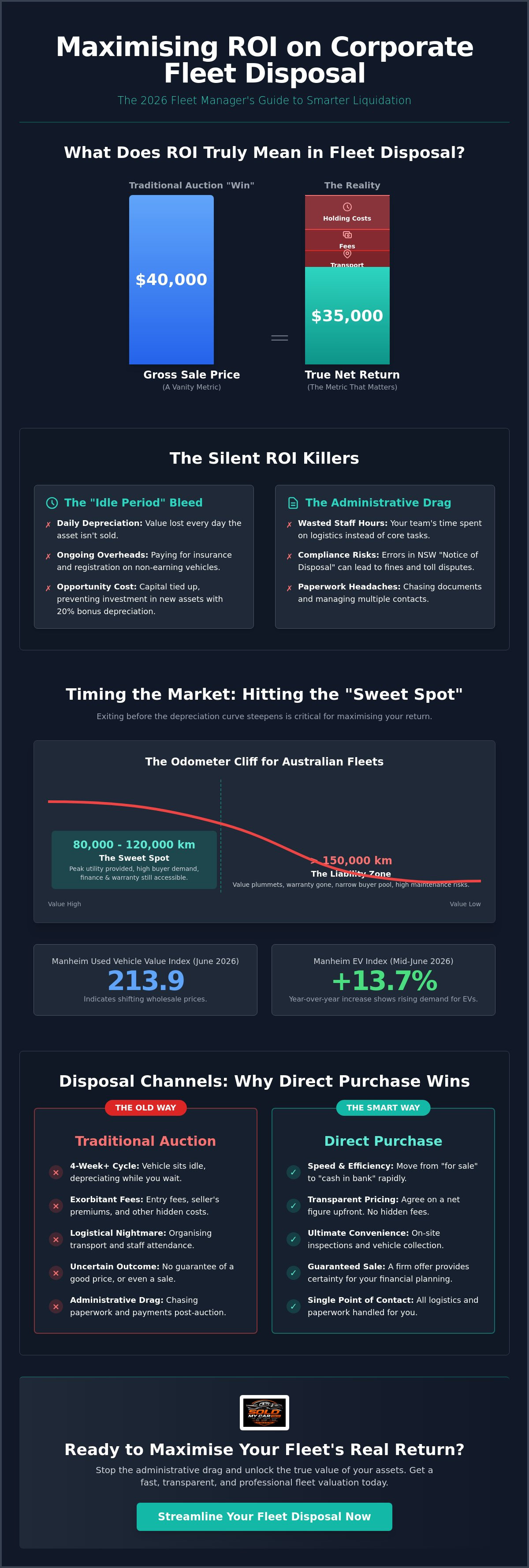
Gross sale price is a vanity metric. It looks brilliant on a spreadsheet but only tells half the story. If you sell a ute for $40,000 at auction but spend $5,000 on transport, entry fees, and staff hours to get it there, your return isn't $40,000. It's $35,000. True success in maximising roi on corporate fleet disposal means looking at the net figure. This is the final sale price minus holding costs, administrative labour, and transaction fees. If your disposal process is slow, your ROI is shrinking every single day.
In the 2026 market, the "idle period" is your biggest enemy. With the Manheim Used Vehicle Value Index sitting at 213.9 as of June 2026, wholesale prices are shifting. A vehicle sitting in your yard for four weeks while you wait for an auction slot is a vehicle losing value. Speed isn't just about convenience; it's a financial necessity. Efficient corporate fleet management requires a fast exit strategy to protect your capital. The faster you move the asset, the more you keep.
The Hidden Costs of Holding Idle Fleet Assets
Depreciation never sleeps. Every week a vehicle sits idle, it bleeds value. Beyond market drops, you're copping ongoing overheads for assets that aren't earning a cent. Think about insurance premiums, registration, and the basic maintenance needed to keep "for sale" units roadworthy. There's also the massive opportunity cost to consider. Every dollar tied up in an ageing asset is a dollar not spent on the 20% bonus depreciation available for new fleet replacements in 2026. Freeing up that cash allows for a faster transition to more efficient hybrids or EVs. Don't let your old fleet hold your new strategy hostage.
Administrative Drag: The Silent ROI Killer
Managing a disposal internally is a massive time sink. Have you calculated the actual hourly cost of your staff handling individual enquiries or auction logistics? It adds up fast and diverts them from high-value tasks. Then there's the compliance risk. In NSW, errors in the "Notice of Disposal" can lead to fine liabilities and ongoing toll disputes that haunt your accounts department for months. It's a mess you don't need. Streamlining your paperwork ensures a total, clean break from the asset. This is why maximising roi on corporate fleet disposal often involves outsourcing the heavy lifting. A professional disposal service handles the lot, removing the drag and letting your team focus on their actual jobs.
Timing the Market: When to Offload Your Fleet for Maximum Value
Timing isn't a guessing game. It's a calculation. In the Sydney market, holding onto an asset past its prime doesn't just lower the final price; it nukes your liquidity. You have to hit the "sweet spot" before the depreciation curve steepens. For most Australian businesses, maximising roi on corporate fleet disposal depends on exiting the asset before major mechanical risks become the buyer's problem. If you wait until a vehicle is "clapped out," you aren't selling an asset. You're offloading a liability.
The 2026 outlook is shifting rapidly. The influx of used EVs is putting serious pressure on traditional petrol residuals. With the Manheim EV Index showing a 13.7% year-over-year increase in mid-June 2026, buyers are actively hunting for modern tech and lower running costs. If you're still running a heavy petrol fleet, you're competing with a growing secondary market of electric options. Sell before the demand for internal combustion engines dips further. The secret to maximising roi on corporate fleet disposal in this climate is moving while petrol demand remains stable.
The Odometer Sweet Spot for Australian Fleets
The 80,000km to 120,000km range is the critical window for corporate car disposal. This is when vehicles still look "fresh" but have provided their peak utility. Most buyers can still secure finance and extended warranties on these units, which keeps your sale price high. Once a prestige fleet vehicle drops its manufacturer warranty, its value falls off a cliff. Maintenance costs start to spike, often exceeding the projected sale value within months. Exceeding 150,000km significantly narrows your buyer pool to wholesale-only or high-risk private buyers.
Market Volatility and Fleet Valuations in 2026
Sydney's market is unique and moves in cycles. Demand for 4WDs and work utes often peaks before the school holidays or the start of the construction season. Urban hatchbacks stay steady, but fuel price spikes can tank the resale value of large-engine vehicles overnight. You must align your exit with these patterns to get the best result. While the U.S. has specific federal Disposal Channels for government fleets, Australian private businesses have more flexibility to move fast. If your maintenance log shows a major service is due, sell now. Don't spend $2,000 on a car you're about to offload. If you're unsure where your vehicles sit on the curve, a quick fleet valuation can clear the fog and help you time the exit perfectly.
Disposal Channels: Why Direct Purchase Beats the Auction Block
Don't get blinded by the hammer price. It's a vanity number that often hides a poor result. The "Auction Illusion" is a common trap for fleet managers. You see a high bid on the screen and assume you've won. Then the invoice arrives. By the time you subtract seller commissions, entry fees, and the cost of transport, your net return has plummeted. Maximising roi on corporate fleet disposal isn't about the highest bid; it's about the highest amount of cash that actually hits your company bank account.
Direct purchase is the modern alternative to the slow, expensive auction cycle. Instead of waiting four weeks for a scheduled event, you get instant liquidity. You skip the middleman and the hidden costs that eat your profit. This approach moves the asset off your books immediately. It stops the clock on depreciation and holding costs. If you want a transparent result without the gamble, direct disposal is the only logical choice.
The True Cost of Public and Dealer Auctions
Sydney auctions are notorious for fee stacking. Commissions can easily strip 10 to 15% off your gross return. Then there's the cost of "dressing" the vehicle. Auctions demand a high visual standard to attract bidders. You'll spend hundreds on professional detailing and minor repairs just to get a look-in. If the car doesn't sell on the day, you're hit with re-entry fees and more storage costs. The logistics are another headache. Moving 20 plus vehicles to an auction centre in Western Sydney requires a fleet of tow trucks or a team of drivers. Every kilometre those cars travel is an added expense and an added risk to your bottom line.
The Direct Purchase Advantage for CFOs
CFOs value certainty above all else. Auctions are a roll of the dice. You're at the mercy of whoever happens to be in the room or online that morning. Direct corporate car disposal services provide a guaranteed, fixed price. This removes the "market whim" factor from your financial reporting. You can forecast your capital recovery with total accuracy. Following 5 Steps to Optimise Your Fleet for a Professional Sale helps you present the assets in their best light for a bulk valuation. Selling a lot of 10 plus vehicles to a single buyer also slashes administrative labour. You deal with one point of contact, one contract, and one payment. This speed and simplicity are essential for maximising roi on corporate fleet disposal while maintaining a lean operation.
5 Steps to Optimise Your Fleet for a Professional Sale
Preparation isn't about making a work ute look like it's never seen a site. It's about removing the "risk discount" from the buyer's offer. If a buyer has to guess the maintenance history or calculate the labour for decal removal, they'll hedge their bets with a lower price. Maximising roi on corporate fleet disposal requires a clinical approach to presentation. You want to prove the asset's value without over-investing in the prep itself. It's a balance. Get it right, and you protect your margin. Get it wrong, and you're just spending money to give the next owner a better deal.
Follow these five steps to streamline the process:
- Consolidate logbooks: Gather every service record. A complete history is the strongest proof of value you have.
- Clean for ROI: Focus on the interior and a basic exterior wash. Avoid expensive paint correction or stage-3 detailing.
- De-brand early: Remove decals and corporate branding. This protects your identity and makes the car "ready to go" for the buyer.
- Build a bulk inventory: Create a clear spreadsheet with VINs, accurate kilometre readings, and rego expiry dates.
- Book a mobile inspection: Stop moving cars around. A mobile valuer comes to your yard, saving you time and transport risk.
Documentation that Drives Value
Paperwork is profit. A complete digital service record can add 5% to 10% to the final offer because it eliminates the buyer's fear of hidden mechanical issues. Don't forget the small things. Spare keys and SD cards for navigation systems are often misplaced in corporate environments. Replacing them is expensive for a buyer, so having them ready prevents a price haggle. Finally, ensure you have a clear title. Any outstanding finance encumbrances will stall the deal. If you want a fast exit, have your payout letters ready to go. You can start the process today by booking a professional fleet and corporate vehicle disposal assessment.
Physical Presentation vs. Over-Repairing
Beware the law of diminishing returns. Spending $1,000 to fix minor bumper scuffs on a vehicle with 120,000km rarely adds $1,000 to the sale price. It's usually a net loss. Professional interior de-odourising is a much better investment. A "work car" smell is a massive turn-off for buyers, whereas a few stone chips are expected. Focus your energy on the legalities too. Managing the "Notice of Disposal" paperwork immediately after the sale is critical. It ensures you aren't liable for the new owner's tolls or speeding fines. This is a vital part of maximising roi on corporate fleet disposal because it prevents "zombie costs" from eating your returns long after the asset is gone.
Streamlining Corporate Liquidation with Sell My Car
Managing a fleet exit shouldn't feel like a second job. We've built a process that prioritises your business's time and bottom line. By cutting out the auction middlemen, we provide a direct path to liquidity. Our approach to maximising roi on corporate fleet disposal is simple. We give you a fair, transparent offer and handle the logistics. Whether you have standard work utes, high-end executive sedans, or even salvage units, we buy them all. No games. No hidden fees. Just a fast, professional transaction that clears your books and your yard.
We bring the power of the Cox Automotive network to your doorstep. This means you get global market intelligence paired with deep local Australian expertise. We understand the Sydney market because we live in it. Our team is unfazed by large-scale liquidations or complex fleet requirements. We simply get the job done. You get the certainty of a fixed price and the speed of a modern disposal partner. It's about moving from asset to cash with zero friction.
The Sydney Mobile Inspection Service
Stop wasting resources moving vehicles across the city. Our Sydney-based mobile team comes directly to your depot, warehouse, or office. This eliminates the need for your drivers to spend hours in traffic or for you to hire expensive car carriers. We conduct on-site inspections and provide same-day valuations for bulk inventories. It keeps your project on schedule and your yard clear. We assess everything from the mechanical condition to the interior wear, providing a comprehensive offer on the spot. For a quick baseline, you can check our Instant Car Valuation Sydney guide for immediate estimates on individual units.
Trusted by Australian Enterprises
Busy fleet managers don't have time for flowery corporate speak. You want results. Our "straight-talk" approach has made us a trusted partner for procurement officers and CFOs across NSW. We take care of the administrative heavy lifting that usually causes bottlenecks in the disposal process. This includes managing complex finance payouts directly with your lenders and ensuring all disposal notices are lodged correctly with Transport for NSW. If you're dealing with a high-end inventory, our specialised Prestige Fleet Vehicle Disposal Sydney service ensures your luxury assets are valued with precision and discretion. We make maximising roi on corporate fleet disposal an effortless part of your asset lifecycle. You get one point of contact, one total solution, and a faster return to your core business activities.
Take Control of Your Fleet’s Capital Recovery
Success in the 2026 market isn't about luck. It's about a disciplined exit strategy. You've seen why the gross hammer price is a vanity metric that hides true costs. You know that hitting the odometer sweet spot and skipping the auction middleman are the fastest ways to protect your capital. Maximising roi on corporate fleet disposal is ultimately about reducing friction and reclaiming your time. Every day an idle asset sits in your yard, your net return shrinks. It's time to stop the bleed.
By choosing a direct path, you eliminate the four-week wait and the fee-stacking that kills margins. We take the stress out of the process with mobile on-site inspections across Sydney and immediate payment for bulk vehicle inventories. As part of Cox Automotive Australia, we provide the scale and reliability your enterprise requires. It's time to stop the administrative drag and get your capital moving again. We've seen every scenario and we're ready to help you navigate yours.
Maximise your fleet ROI today; get a professional corporate valuation from Sell My Car. Let's get those assets off your books and the cash back into your business where it belongs.
Frequently Asked Questions
Is it better to trade in fleet vehicles or sell them to a corporate car disposal service?
Selling to a corporate disposal service usually beats a trade-in because it offers a direct wholesale price without the dealer's retail margin. Trade-ins are convenient but often result in a lower valuation since the dealer needs to profit on the resale. A direct disposal service gives you cash in hand and the freedom to buy your next fleet from any manufacturer. It keeps your options open and your returns higher.
How do I calculate the net ROI on a fleet vehicle sale?
Calculate your net ROI by subtracting every transaction and holding cost from the gross sale price. Start with the final cash received. Subtract transport fees, detailing costs, and the staff hours spent managing the process. Don't forget to account for depreciation and insurance paid while the vehicle sat idle. This final figure is your true measure of success in maximising roi on corporate fleet disposal.
What are the holding costs for a fleet vehicle that isn't being used?
Holding costs include every dollar spent on a vehicle while it sits idle in your yard. You are paying for insurance premiums, registration, and depreciation every single day. There is also the cost of yard space and the occasional battery or tyre maintenance needed for stationary units. These "silent" expenses can quickly drain a significant portion of a vehicle's value every month it remains unsold and off the road.
Can I sell a fleet of vehicles that still have finance remaining?
Yes, you can sell fleet vehicles even if they have outstanding finance encumbrances. We handle the payout process directly with your financier to make the transition seamless for your accounts team. Once we agree on a purchase price, we pay the lender the remaining balance and transfer the surplus funds to your business account. This clears the liability from your balance sheet and settles the debt in one step.
Does Sell My Car handle the 'Notice of Disposal' paperwork for NSW?
We take care of the "Notice of Disposal" paperwork for all NSW fleet transactions. This is a critical step to ensure your company is not held liable for tolls, parking fines, or speeding tickets incurred by the new owner. We lodge the details with Transport for NSW immediately after the sale is finalised. You get a clean break from the asset and total peace of mind regarding future liabilities.
What happens to the value of my fleet if I miss the 100,000km service interval?
Missing a major service interval like the 100,000km mark significantly hurts your resale value. Buyers view a skipped logbook entry as a sign of potential mechanical neglect. It often triggers a "risk discount" in their offers that far exceeds the actual cost of the service itself. If you have missed a major interval, be transparent. Providing recent repair receipts for other maintenance can help mitigate the hit to your bottom line.
How quickly can a corporate fleet be liquidated in Sydney?
A corporate fleet can be liquidated in as little as 24 to 48 hours with a direct purchase service. Unlike the traditional auction cycle which takes weeks to organise, our mobile team conducts on-site inspections across Sydney and provides immediate offers. Once you accept the valuation, we arrange for fast payment and vehicle collection. This speed is a major factor in maximising roi on corporate fleet disposal by stopping the clock on depreciation.
Do I need to remove company branding before selling my fleet cars?
You should remove company branding to protect your corporate identity and improve the vehicle's appeal to a wider range of buyers. While we can purchase vehicles with decals still attached, removing them beforehand is best practice. It prevents your brand from being associated with the vehicle's future use or condition. It also allows the valuer to see the true state of the paintwork, which can lead to a firmer and fairer offer.