That unregistered heap on your nature strip is a liability, not a goldmine. Thinking you'll pocket more cash by stripping your car for parts yourself is a trap that usually ends in greasy hands and a garage full of oily bits you can't sell. You've dealt with the tyre-kickers on Facebook Marketplace before. They waste your Saturday morning messaging about a fifty-dollar door handle and then never show up. Meanwhile, the council is just waiting for an excuse to hit you with a fine for keeping a wreck on the street. It's frustrating, messy, and honestly, you've got better things to do with your time.
We know you want the highest possible return for your salvage vehicle without the mechanical headache. This guide shows you how to turn that non-runner into immediate cash today without ever picking up a spanner. We'll walk you through a simple three-step process to get the vehicle removed fast, get paid on the spot, and lodge your Notice of Disposal within the required 14 days. You'll walk away with a fatter wallet and zero legal loose ends with Transport for NSW. Let's get that driveway cleared.
Key Takeaways
- Understand when a vehicle officially becomes a car for parts and why the sum of its components often outweighs its value as a functional unit.
- Avoid the "DIY trap" by weighing up the hidden costs of engine hoists and oily floor stains against the speed of professional disposal.
- Identify the high-value components, such as gearboxes and catalytic converters, that have the biggest impact on your final cash offer.
- Follow a streamlined 4-step process to organise your paperwork and secure an accurate valuation without the headache of private buyers.
- Learn how to offload your salvage vehicle quickly while ensuring you meet all legal requirements with Transport for NSW.
What Exactly is a 'Car for Parts'?
A car for parts isn't just a dead vehicle taking up space in your driveway. It's a mathematical equation. From a professional perspective, a vehicle transitions into this category when the sum of its individual components is worth more than the car as a functional unit. It's about cold, hard numbers. If fixing a blown head gasket or a shattered gearbox costs five grand, but the car is only worth four grand on a good day, you've reached an "uneconomical repair" verdict. At this point, the car stops being a mode of transport and starts being inventory.
Several common scenarios lead to this outcome in Sydney. Major mechanical failures are the usual suspects. However, structural rust that prevents you from getting a pink slip is just as terminal. Even a car with a perfect interior can become a donor if the chassis is compromised. Sydney roads and our coastal air can be brutal on older steel. When the cost of getting the vehicle back to a roadworthy state exceeds its market value, selling the whole unit for its components is the only logical move left.
Salvage vs. Scrap: Know the Difference
Don't confuse "scrap" with "salvage." They aren't the same thing. Scrap value is determined almost entirely by the weight of the metal. You're essentially selling the car to be crushed and melted down. Salvage value is where the real money lives. This refers to the usable parts still bolted to the frame. A professional Wrecking yard looks for these high-value items to resell to other drivers. If your car has a working alternator, mint condition leather seats, or "straight" body panels with no dents, you aren't just selling scrap metal. You're selling a car for parts that can keep five other vehicles on the road. Knowing this distinction helps you understand why some offers are higher than others.
Why Your 'Junk' is Valuable to Wreckers
Sydney buyers are always on the hunt for specific donor vehicles. Common models like Corollas or Hiluxes are in high demand because there are so many of them on our roads. When a tradie needs a replacement door or a commuter needs a mirror, they'd rather pay for a quality used part than wait weeks for a brand-new one from overseas. Prestige European makes are even more sought after. New parts for a BMW or Audi can be eye-wateringly expensive. A wrecker sees your "junk" as a vital source of affordable components for the local market. They have the tools and the space to extract that value, which is why they're willing to pay you cash to take the headache off your hands.
DIY Stripping vs. Selling Whole: The Reality Check
Many Sydney drivers think they'll make a killing by stripping their car for parts on a Saturday morning. It sounds like a solid plan until you're three hours deep into a seized bolt with a bruised knuckle and a driveway covered in transmission fluid. DIY dismantling isn't just about having a set of spanners. You'll need engine hoists, specialized torx sockets, and a floor you don't mind ruining with permanent oily stains. Most people end up spending more on tools and degreaser than they ever make back from selling a few sensors on the weekend.
Storage is the next hurdle. Sydney real estate is far too expensive to use your garage as a graveyard for old doors and gearboxes. If you take a car apart, you're left with bulky components taking up space for months while you wait for the right buyer to scroll past your ad. Then comes the shipping nightmare. Dealing with the logistics of sending a heavy alternator or a bumper across the state is a massive drain on your time. Professional buyers look at the big picture. They use specific data to determine a vehicle's ACV, factoring in the current demand for components without you having to lift a finger or clear out the shed.
If the thought of oily hands and endless marketplace messages sounds like a headache, a mobile vehicle purchase is the smart way to go. You get the cash, we take the car, and your driveway stays clean.
The Time-Value Equation for Aussie Sellers
You need to value your own time. If it takes you 40 hours to strip, clean, list, and sell components just to make an extra few hundred bucks, you're working for peanuts. Your weekends are better spent at the beach or with the family than haggling with strangers over a second-hand starter motor. Professional disposal is about speed and efficiency. We move the reader quickly from a dead wreck to a cleared space. It's about getting the job done so you can move on with your life.
Environmental Risks of Backyard Stripping
Backyard stripping isn't just messy; it's a legal minefield. When you pull an engine, you're dealing with coolant, brake fluid, and old oil. In NSW, the EPA and local councils have strict rules about how these fluids are handled. One accidental spill down the storm drain can lead to massive fines that dwarf the value of the car. Licensed buyers are equipped to drain and recycle these fluids safely. They ensure your car for parts doesn't become an environmental liability for your neighbourhood.
Calculating the Value of Your Parts Car
Pricing a car for parts isn't a guessing game. It's a calculation based on what's left on the bone. Don't expect a windfall for a rusted-out sedan from the nineties with 400,000 kilometres on the clock. The market determines the price. If your vehicle has high-demand components that are hard to find in Sydney wrecking yards, the value climbs. If it's a common model with a blown engine but perfect body panels, you're still in the money. We look at the current secondary market for every bolt and sensor to give you a fair shake.
Sydney's scrap metal market is volatile. As of June 2026, pressing steel fetches between $0.15 and $0.25 per kg. That's the floor price. To get a better result, you need to look at the salvageable bits. High mileage is the biggest value killer for engines and transmissions. A gearbox with 50,000 kilometres is worth three times more than one that's done 250,000. Before you sign anything, make sure you understand the NSW notice of disposal requirements. It's a critical step to ensure you aren't held liable for the vehicle once it's out of your hands.
The 'Big Three' Components That Drive Price
Three main items move the needle on your valuation. First, catalytic converters. They contain precious metals like platinum and palladium. Even on a dead car, these are worth significant cash. Second, the transmission. If your gearbox is smooth and functional, it's a high-ticket item for someone facing a three-thousand-dollar repair bill. Finally, 'straight' body panels. Dents are expensive to fix. A factory-painted door or bonnet in good nick is gold to a smash repairer. If these three are intact, your car for parts is worth a lot more than its weight in steel.
Does a Luxury Badge Mean More Cash?
The short answer is yes. European makes like BMW, Audi, and Mercedes-Benz carry a prestige premium. Why? Because new parts for these brands are eye-wateringly expensive and often have long wait times for shipping. A local Sydney mechanic would much rather buy a verified used alternator for a 2018 3-Series than wait three weeks for a part from Germany. However, this only applies if the tech is still relevant. A luxury car from twenty years ago might actually be worth less than a late-model Toyota because nobody is looking for those specific sensors anymore. Demand drives the dollar.
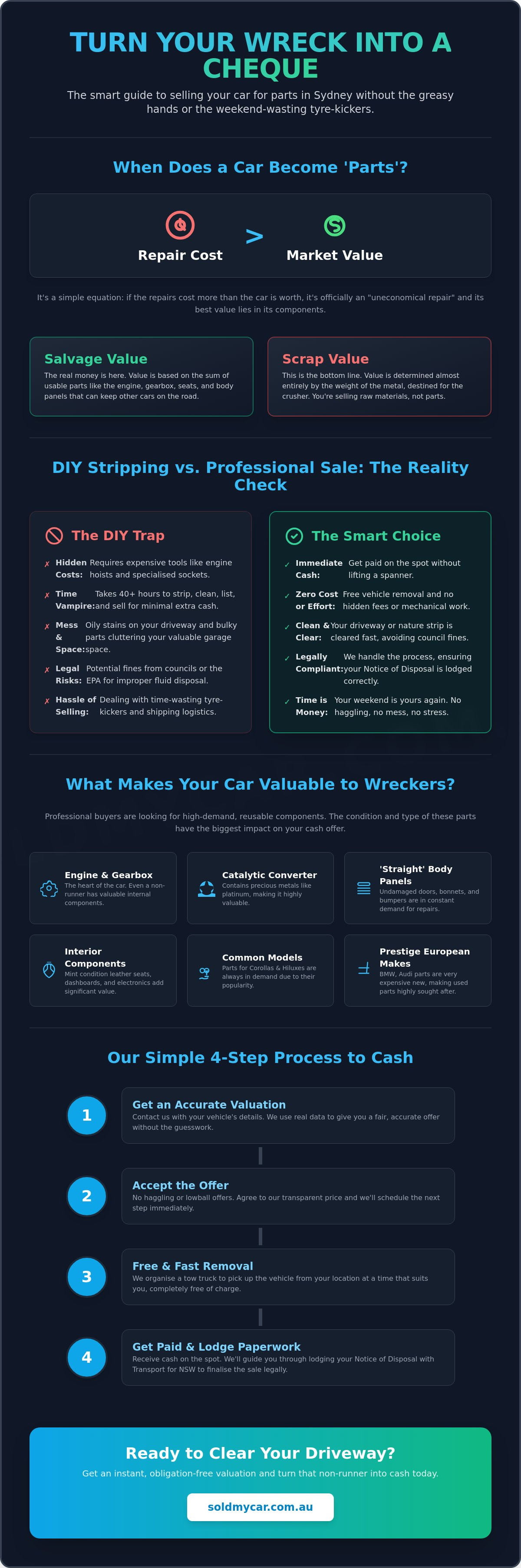
How to Sell Your Car for Parts in 4 Steps
Moving a car for parts doesn't have to be a drawn-out drama. If you follow a methodical process, you can go from an eyesore in the driveway to cash in your hand within twenty-four hours. Forget the endless back-and-forth of private listings. This is about a clean break and a fast transaction. Follow these four steps to ensure you get the best result without the typical salvage headaches.
Step 1: Collate your paperwork and clear the decks. You need proof of ownership, usually your registration papers, and a valid photo ID. Before the tow truck arrives, do a final sweep of the cabin. Check under the seats, in the glove box, and deep in the boot pockets. People often leave behind E-Toll tags, house keys, or even old logbooks that contain personal information. Once the car is gone, those items are likely lost forever.
Step 2: Get your numbers right. Don't fly blind. Use an instant car valuation Sydney tool to set a realistic baseline for what your vehicle is worth in its current state. This gives you the confidence to recognize a fair offer when you see one. Knowing the value of your specific make and model prevents you from accepting a generic "scrap" price for a high-value salvage vehicle.
Step 3: Organise the removal logistics. Be honest about the vehicle's condition. If the wheels are locked or the engine is completely seized, the buyer needs to know. They'll need to bring a tilt-tray truck rather than a standard dolly tow. Clear a path so the driver can get in and out quickly. If the car is blocked by other vehicles or rubbish, move them beforehand to avoid delays.
Step 4: Finalise the legalities. This is the most important part for your peace of mind. Once the deal is done, you must notify the authorities to stop being liable for the vehicle. If you're ready to move now, you can get cash for cars Sydney and have the whole process handled by professionals who know the paperwork inside out.
The Legal Bit: Notice of Disposal and Rego Plates
In NSW, you have a strict 14-day deadline to submit a Notice of Disposal (NOD) after selling or disposing of a vehicle. This is non-negotiable. If you sell the car with the number plates attached, the NOD is your shield against future fines. However, if you choose to remove the plates to keep them or for a refund, you must cancel the registration instead. Failing to do this correctly can lead to a world of pain with Transport for NSW down the track.
Preparing the Vehicle for a Fast Pickup
Speed is the goal. A professional buyer wants to be in and out in fifteen minutes. Ensure the car is on level ground if possible. If the battery is dead but the car needs to be shifted into neutral, have the keys ready. A little bit of preparation goes a long way in ensuring the transaction is smooth and you get paid without any last-minute haggling over access issues.
Why Sell My Car is the Smart Choice for Salvage
Selling a car for parts privately is a full-time job you never asked for. You spend your nights fielding "is this still available" messages from people who have no intention of showing up. We cut through that mess. We are the direct buyer. This means no middlemen, no flaky private buyers, and no waiting for someone to "check with their wife" before committing. We make the offer, we show up, and the vehicle is gone. It's that simple. We value your time above all else.
We handle all the junk car removal Sydney logistics so you don't have to lift a finger. Don't worry about hiring a tilt-tray or convincing a mate to help you push a dead wreck onto a trailer. Our team arrives with the heavy-duty equipment needed for a safe extraction. Whether the car is stuck in a narrow driveway or has four flat tyres, we deal with the heavy lifting. You just need to be there to hand over the keys and collect your payment.
Our valuations are backed by real-time Sydney auction and salvage data. We don't guess. We look at what your specific components are worth on the secondary market right now. This professional approach ensures you get a fair price based on actual demand, not just a low-ball scrap metal quote. We offer a straight-talk service. We buy the car as-is and where-is, which means no last-minute haggling over a scratch or a missing hubcap. We project total competence so you can relax.
From Non-Runner to Cash in 24 Hours
We've built our reputation on high-speed reliability. The process is designed to move you from a problem to a solution in record time. We use a simple three-step progression to keep things manageable. First, request your valuation through our online tool. Second, review and accept our transparent offer. Third, schedule your pickup and get paid immediately. We aim to lower your stress by being decisive. You don't need mechanical knowledge or a garage full of tools to get a great result for your car for parts. You just need a partner who values efficiency.
The Cox Automotive Advantage: Global Tech, Local Service
We bring the massive scale of Cox Automotive's global data to the streets of Sydney. This gives us a decisive edge in pricing accuracy that smaller local wreckers simply can't match. However, we still operate with the "one of us" attitude you expect from a trusted local peer. We're the bold, modern alternative to traditional disposal methods. We pride ourselves on integrity and straightforwardness. When you sell to us, you're choosing a professional who has seen it all and remains unfazed by the toughest salvage jobs. Let's get that wreck out of your sight today.
Clear Your Driveway and Get Paid Today
Selling your car for parts shouldn't be a months-long saga of greasy hands and unread messages. You now know that DIY stripping often costs more in tools and time than it actually returns. You also understand that high-value salvage bits like catalytic converters and straight panels are what really drive your offer up. Most importantly, you've got the roadmap to stay legally clear with Transport for NSW by hitting those notice of disposal deadlines.
Stop letting that non-runner collect dust and council warnings. As part of Cox Automotive Australia, we bring world-class tech to your local Sydney street. We provide a mobile inspection service across the entire Sydney basin and offer instant payment for salvage vehicles. No haggling. No "mate's rates" nonsense. Just a professional, high-speed transaction that respects your time. Reclaim your space and put that cash to better use.
Get a Fair Dinkum Offer for Your Parts Car Now and let us handle the heavy lifting while you move on with your weekend. You're just one click away from a clean driveway.
Common Questions About Sydney Car Disposal
Can I sell a car for parts without the logbook or service history?
Yes, you can sell a car for parts without a logbook or service records. While a full history helps us value high-end prestige models, it isn't a legal requirement for disposal. You just need to provide proof of ownership and a valid photo ID so we can verify you have the right to sell the vehicle.
Do I need to cancel my registration before selling to a wrecker?
It depends on what you plan to do with the number plates. If you sell the vehicle with the plates attached, you don't need to cancel the rego, but you must submit a Notice of Disposal. If you want to keep your personalised plates or claim a rego refund, you should cancel the registration and remove the plates before the tow truck arrives.
What is the most valuable part of a car for scrap?
Catalytic converters are typically the most valuable components because they contain precious metals like platinum and palladium. Beyond the metals, functional high-demand items like gearboxes and engines fetch the best prices in the salvage market. We look at these specific parts to give you a better offer than a simple weight-based scrap price.
How do I lodge a Notice of Disposal in NSW for a parts car?
Submit your Notice of Disposal online via the Service NSW website for the fastest result. You are legally required to do this within 14 days of the sale. This process officially transfers responsibility for the vehicle, protecting you from any future fines or tolls incurred by the new owner.
Will Sell My Car pick up a vehicle that doesn't start?
We specialise in non-runners and salvage vehicles that are no longer roadworthy. Our team uses professional tilt-tray trucks to safely remove cars that can't move under their own power. Just let us know the car is a non-starter when you request your valuation so we can bring the right equipment for a fast pickup.
Is it legal to sell a car for parts if it has finance remaining?
No, you cannot legally sell a car for parts if it has an active encumbrance. The finance must be paid out in full and the security interest cleared before any sale can take place. If you're looking to clear a debt, contact your lender for a payout figure first so you can settle the balance.
How much is a scrap car worth in Sydney in 2026?
Scrap metal prices for pressing steel currently range between $0.15 and $0.25 per kg in Sydney as of June 2026. However, selling a car as a whole unit for salvage usually pays more than the raw metal price. We calculate the value based on the reusable components rather than just the weight of the steel.
Can I keep my personalised plates when I sell for parts?
You can definitely keep your personalised plates. You'll need to remove them from the vehicle and visit a Service NSW centre to either put them on hold or transfer them to another car. Make sure this is done before the vehicle is towed away, as plates are often destroyed during the recycling process.