

Your fleet strategy is only as good as its exit. Real ROI isn't found in the fine print of a new lease. It's found in how quickly you can turn old steel into liquid capital. Most managers wait too long. They watch newer models depreciate at lightning speed while ageing utes rack up maintenance bills that bleed the budget dry. It's a common trap. To stay ahead in this market, you need a proactive fleet vehicle disposal strategy Australia wide that treats every vehicle like a ticking clock.
We know the feeling. Disposing of a dozen vehicles at once is usually an administrative nightmare that kills your entire week. It doesn't have to be that way. This guide shows you how to nail your turnover timing and liquidate assets without the usual corporate red tape or headaches. We'll walk through the 2026 replacement framework, show you how to pull maximum capital from old assets, and provide a zero-friction disposal process to get the job done. No fluff. Just a clear path to better returns.
Key Takeaways
- Identify the exact "sweet spot" for turnover to retire vehicles before rising maintenance costs swallow your residual value.
- Build a robust fleet vehicle disposal strategy Australia wide that balances 2026 EV trends with the high resale value of traditional diesel utes.
- Cut through the noise of auctions and dealer trade-ins to find the disposal method that actually puts the most cash back in your business.
- Use our five-step framework to audit your assets and categorise vehicles by exit urgency for a faster, cleaner liquidation process.
- Learn how to liquidate fleets of any size with a single point of contact, removing the administrative nightmare of multiple transactions.
Optimising Your Fleet Vehicle Replacement Strategy in Australia for 2026
A fleet replacement strategy isn't a "gut feeling" or a guess based on how many kilometres are on the clock. It's a data-driven blueprint. You need to retire vehicles precisely before maintenance costs overtake their residual value. In the world of Fleet Management Overview, this is the difference between a profitable operation and a sinking ship. A solid fleet vehicle disposal strategy Australia wide ensures you're selling when the market is hungry, not when the car is falling apart. It's about staying ahead of the curve.
2026 marks a massive turning point for local businesses. The New Vehicle Efficiency Standard (NVES) is now in full swing, pushing manufacturers to flood the market with EVs and hybrids. However, the legendary Aussie diesel ute still commands top dollar on the used market for now. Balancing these two worlds is the challenge. Supply chains have finally stabilised this year. This means you can actually get your hands on new stock without an 18-month wait. It makes timing your exit easier than it’s been in years. You have the power to choose your timing again.
The Hidden Costs of Holding On Too Long
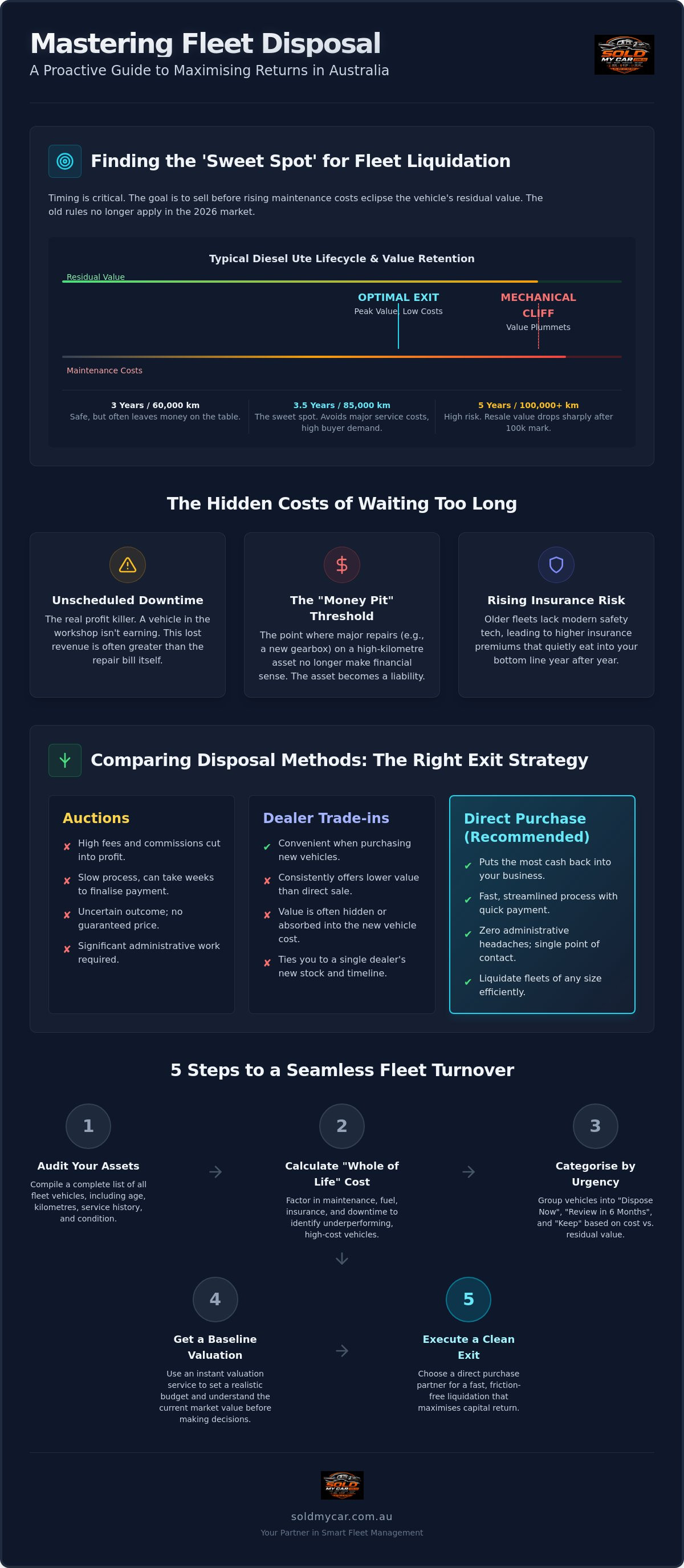
Calculating the "Whole of Life" cost is the only way to see the true picture. It’s not just about the monthly lease or the initial buy price. Unscheduled downtime is the real profit killer for Australian small businesses. If a tradie's ute is sitting in the workshop for three days, that’s three days of lost revenue you’ll never get back. This is the "Money Pit" threshold. It's that point where a two-grand gearbox repair on a high-kilometre asset just doesn't make sense. By 2026, safety tech has also leaped forward. Older fleets lacking the latest crash-avoidance systems are quickly becoming an insurance risk. This often leads to higher premiums that eat into your bottom line.
Why 2026 Market Volatility Demands a Proactive Exit
The Australian used car market is finally cooling off after the record-breaking highs of the early 2020s. Prices are stabilising. This means a "wait and see" approach will cost you money as values drop back to earth. Recent Fringe Benefits Tax (FBT) changes, particularly the exemptions for eligible electric vehicles, are also shifting how companies cycle their assets. To stay ahead, you need a baseline. Getting an instant car valuation Sydney is the fastest way to set your 2026 budget. It helps you decide exactly which units need to go before they lose more value. Don't wait for the next major service to find out your asset is now a liability. Act while the numbers still work in your favour.
Finding the 'Sweet Spot' for Fleet Liquidation
Timing is everything. A successful fleet vehicle disposal strategy Australia wide relies on hitting the exit window before depreciation accelerates. Most managers default to a standard 3-year or 5-year cycle. However, the 2026 market is more nuanced. The old 3-year/60,000km rule is safe, but it often leaves money on the table. Pushing to 5 years or 100,000km might seem frugal, but you risk hitting the "mechanical cliff" where resale values plummet. You need to find the balance between maximum usage and peak residual value.
Aussie utes are the exception to the rule. While a standard passenger sedan might lose 50% of its value in three years, a well-maintained 4x4 HiLux or Ranger often retains significantly more. This is because they are seen as tools of trade rather than just transport. According to the Australasian Fleet Management Association, lifecycle costs are lowest when you replace assets before they require major overhauls. Don't wait for the End of Financial Year (EOFY) to sell. Every business in Australia dumps stock in June. This floods the market and drives prices down. Sell in February or March when supply is tighter and demand is high.
Analysing Odometer vs. Age in the Aussie Market
The 100,000km mark is a massive psychological barrier for second-hand buyers. Once that six-figure digit appears on the dash, your pool of potential buyers shrinks instantly. In regional NSW or Western Sydney, highway kilometres are often viewed more favourably than city driving, but the odometer reading still dictates the final offer. For a 2026 Toyota HiLux, the optimal exit window is at the 3.5-year mark or 85,000 kilometres, just before the secondary market loses interest in "work-ready" warranty coverage. Selling at 90,000km allows you to bypass the expensive 100,000km major service and timing belt replacement, saving your business thousands in workshop bills.
Residual Value: The Only Metric That Actually Matters
Stop relying on outdated book values. Real-time market data is the only way to track what your assets are actually worth. This is especially true for high-end assets. If you are managing executive fleets, selling prestige car Sydney requires a different approach to recover maximum capital. You also need to prepare for the "EV Cliff." As electric vehicle range improves and new prices drop, older internal combustion engine (ICE) models will face steeper depreciation. Transitioning your fleet out of petrol and diesel units while demand is still high is a critical move for 2026. If you're unsure where your current assets sit on the value curve, get a professional fleet assessment to see the real numbers.
Comparing Disposal Methods: Auctions vs. Trade-ins vs. Direct Purchase
Choosing the right exit path is just as critical as timing the market. You can have the perfect fleet vehicle disposal strategy Australia wide, but if you pick a leaky bucket to move your assets, you'll lose your margin to fees and delays. Most corporate managers lean on auctions or dealer trade-ins because that is "how it’s always been done." In 2026, those methods are often the most expensive ways to say goodbye to a vehicle. You need to look at the net return, not just the headline figure.
Auctions offer the illusion of top dollar. The reality is far grittier. Once you factor in 10% commissions, transport costs to the yard, and detailing fees, your "record price" starts looking thin. Even the NSW Government fleet disposal guidelines highlight the need for mandated, efficient contracts to ensure value for money. Trade-ins aren't much better. Dealers love to "wash" the profit by giving you a slightly higher trade-in price while refusing to budge on the new car's sticker price. Direct purchase is the 2026 standard. It’s for businesses that value certain cash flow and zero administrative drama.
Why Auctions Aren't Always the 'Safe Bet'
The biggest risk at auction isn't a low price; it's a "No-Sale." If your asset doesn't hit the reserve, it sits. You keep paying for insurance, storage, and depreciation while the car gathers dust. This lack of price transparency makes budgeting a nightmare. Many businesses are now moving toward fixed-price acquisitions to avoid this "Auction Hangover." Securing a guaranteed corporate buy-back means you know the exact dollar amount hitting your account before the car even leaves your depot. It’s predictable, fast, and final.
The Trade-In Trap: Hidden Costs in New Contracts
When you trade in a fleet, you lose your greatest negotiating tool: being a cash buyer. Dealers use your old cars to complicate the math on your new 2026 fleet lease. By separating the disposal from the acquisition, you gain total clarity on both ends of the deal. You can squeeze the dealer for a better price on the new units because you aren't asking them to take on your old problems. For those managing high-end assets, prestige fleet vehicle disposal Sydney requires a cleaner alternative than a standard dealership lot. We handle the heavy lifting, including the Notice of Disposal and PPSR clearing, so your team doesn't spend Friday afternoon chasing paperwork. It’s about making the exit as professional as the entry.
5 Steps to Executing a Seamless Fleet Turnover
Execution is where most managers stumble. You can have the best fleet vehicle disposal strategy Australia has to offer, but poor logistics will still kill your ROI. Moving from a strategy to a finished sale requires a methodical approach. It’s about removing friction at every stage. Follow these five steps to turn your retiring assets into capital without the usual corporate headaches.
- Step 1: Audit and Categorise. Don't treat the fleet as a single block. Categorise every vehicle by "Exit Urgency." Units with high maintenance costs or expiring warranties go first.
- Step 2: Consolidate Documentation. Gather service records and verify PPSR status early. Missing logbooks or encumbered titles cause delays that cost you money.
- Step 3: Secure an Independent Valuation. Get a real-world figure that reflects the 2026 Sydney market. Book values are often six months behind the actual street price.
- Step 4: Execute a Bulk Disposal. Sell to a single professional buyer. This eliminates the logistics of moving cars to different yards or dealing with multiple points of contact.
- Step 5: Reinvest the Capital. Use the immediate cash injection to fund your new fleet. This reduces your reliance on high-interest financing for the 2026 cycle.
Auditing Your Current Inventory
Start by identifying the "lemons." These are the high-maintenance units that spend more time in the workshop than on the road. You also need to check rego and CTP expiry dates across the board. Selling a car with no rego often leads to price penalties that far outweigh the cost of a short-term renewal. If your fleet is spread across multiple job sites, use a mobile vehicle purchase service. This allows you to audit and value vehicles where they sit, saving you the cost and hassle of towing them to a central depot for inspection.
Preparing Documentation for a Professional Sale
Professional buyers want the "Essential Three": logbooks, spare keys, and clear titles. If a vehicle is still under finance, get an official payout letter from your lender. This transparency builds trust and speeds up the transaction. Providing a clear PPSR certificate is the fastest way to close a fleet sale because it proves the vehicle is free from debt and legal complications. It removes the guesswork for the buyer and ensures the funds hit your account sooner. Don't let a missing spare key or a messy service history shave thousands off your return.
Ready to clear the lot and boost your bottom line? Contact our fleet disposal experts for a streamlined bulk offer on your entire inventory.
Streamlining Your Exit Strategy with Sell My Car
The final step of any successful fleet vehicle disposal strategy Australia wide is the actual exchange of keys for capital. You have done the hard work of auditing your inventory and timing the market. Now you need a partner who moves as fast as your business does. Most corporate disposal routes are clogged with middle-men, hidden fees, and month-long wait times for funds to clear. We have stripped that away. Our process is built for speed, transparency, and total reliability.
We buy fleets of any size. Whether you are offloading 2 vehicles or 200, you deal with a single point of contact from start to finish. This removes the administrative nightmare of managing multiple buyers or chasing different auction houses. There are no private classifieds to manage. No tyre-kickers to waste your time. No auction uncertainty where you hope for a result that might never come. We provide a firm, professional offer, allowing you to close the books on your old assets and move forward with confidence.
Why Sydney Businesses Partner with Us
We take a straight-talk approach to every transaction. You won't find any corporate jargon or hidden "processing fees" here. Our team provides honest valuations based on real-time 2026 market data. As part of the Cox Automotive Australia family, we combine global industry expertise with a deep, local Sydney focus. We understand the specific demands of the NSW market. Our capability is broad. We handle everything in a single go, from high-end executive prestige sedans to providing cash for scrap cars if you have older, non-running salvage units cluttering your depot. It’s a one-stop shop for your entire exit strategy.
From Valuation to Payment: The Fast-Track Process
Time is money. We don't believe in dragging out the valuation process. You can get a comprehensive bulk fleet valuation in under 24 hours. Once the offer is accepted, we move even faster. Our Sydney-based mobile inspectors come directly to your office or depot. They verify the assets on-site, so your team doesn't have to spend days shuttling cars across the city. We handle all the NSW paperwork, including the Notice of Disposal and PPSR clearing. Payment is immediate. We also take care of the logistics. We manage the transport and pick-up of every vehicle, ensuring your yard is clear without you lifting a finger.
Ready to clear the lot and maximise your returns? Get a professional fleet disposal offer today and see how simple a corporate exit can be.
Take Control of Your Fleet Turnover Today
Success in fleet management isn't just about what you buy; it's about how you exit. You now have the framework to identify the perfect turnover "sweet spot" and avoid the mechanical cliff that drains your budget. By choosing direct liquidation over the uncertainty of auctions, you protect your margins and keep your team focused on the core business. A robust fleet vehicle disposal strategy Australia wide ensures your capital stays fluid and your fleet remains modern.
Stop letting old assets sit in the yard losing value every day. We make the process simple. As a part of the Cox Automotive family since 2013, we provide the security of a global leader with the speed of a local partner. We offer mobile inspections across Sydney and direct payment into your account. There are no auction fees and no middle-men; just a clean, fast transaction that respects your time and your bottom line. It's time to clear the lot and reinvest in your future growth.
Get a Fast, Direct Offer for Your Fleet Vehicles
Frequently Asked Questions
How often should an Australian business replace its fleet vehicles?
Most Australian businesses should aim to replace vehicles every 3 to 5 years or before the odometer hits 100,000 kilometres. This window allows you to avoid the "mechanical cliff" where maintenance costs spike and resale values plummet. Replacing assets while they are still under warranty also makes them far more attractive to professional buyers, ensuring a faster liquidation process.
Is it better to lease or buy fleet vehicles in 2026?
Buying vehicles outright often offers a better long-term ROI because it gives you total control over your fleet vehicle disposal strategy Australia wide. While leasing provides predictable monthly outgoings, it often locks you into rigid replacement cycles. Buying allows you to time your exit based on real-time market demand, helping you capture peak residual value when supply is tight.
What is the best way to dispose of a large corporate fleet in Sydney?
Direct purchase from a professional fleet specialist is the most efficient method for Sydney businesses. This path removes the uncertainty of auctions and the lowball offers common with dealer trade-ins. You get a single point of contact, mobile inspections at your depot, and immediate payment. It eliminates the cost of transporting dozens of vehicles to a central auction yard.
Does a high odometer reading drastically affect fleet resale value in Australia?
Yes, the 100,000km mark is a major psychological barrier that significantly lowers resale value in the Australian market. Second-hand buyers view this number as the start of expensive major services and potential part failures. Selling at 85,000km often results in a much higher net return because you bypass the 100,000km timing belt replacement and other high-cost repairs.
Can I sell fleet vehicles that still have finance remaining?
You can absolutely sell vehicles with remaining finance by providing an official payout letter from your lender. A professional buyer will clear the debt directly with the financier and pay the remaining equity into your business account. This process is straightforward and removes the need for your business to find the cash to clear the titles before selling.
What paperwork is required for fleet vehicle disposal in NSW?
In NSW, you must provide a completed Notice of Disposal (NOD) for each vehicle to end your liability for future tolls and fines. You also need the original logbooks, spare keys, and a clear PPSR certificate to prove the vehicle is free from debt. Having this documentation organised before the inspection is the fastest way to ensure a same-day settlement.
How do I calculate the residual value of my fleet accurately?
Accurate residual value comes from real-time market tracking rather than outdated book values. You should look at what similar models with comparable specifications are actually selling for on the used market today. Factor in current supply levels and the growing demand for specific assets like 4x4 utes or hybrids, as these often hold their value better than standard sedans.
Are there tax benefits to replacing my fleet before the end of the financial year?
Yes, replacing fleet assets before 30 June can trigger significant tax deductions, including depreciation claims and potential instant asset write-offs. However, don't wait until the final week of June to sell. The market is often flooded with stock during this period, which can drive down your sale price and negate the benefits of the tax deduction.