

A handshake deal on a fleet sale is a ticking time bomb for your balance sheet. If you don't nail the paperwork, you're still on the hook for every toll, fine, and legal headache that follows that car down the road. Securing a certificate of disposal for company vehicles is about more than just clearing space in the car park. It's your only ironclad way to prove to the ATO and state authorities that the vehicle is no longer your problem.
We know the frustration. You're trying to move stock while figuring out why one state wants a paper form and another demands an in-person visit. It's a massive time sink. This guide cuts through the noise to help you master the legal requirements for 2026. You'll learn the exact steps to offload your fleet vehicles without the tax or liability drama. We'll cover state-specific deadlines, the vital difference between a Notice of Disposal and a Certificate of Destruction, and how to keep your audit trail spotless for the next tax season.
Key Takeaways
- Learn why a lodged Notice of Disposal is the only way to sever legal liability and stop fines from hitting your desk.
- Master the process of obtaining a certificate of disposal for company vehicles to satisfy both Transport for NSW and the ATO.
- Organise your internal records to provide a clean audit trail for FBT logbooks and depreciation schedules.
- Navigate the specific requirements for statutory and repairable write-offs when disposing of salvage or end-of-life fleet assets.
- Discover how a direct B2B transaction with a licensed dealer can handle the paperwork for you and ensure an immediate legal break.
What is a Certificate of Disposal for Company Vehicles?
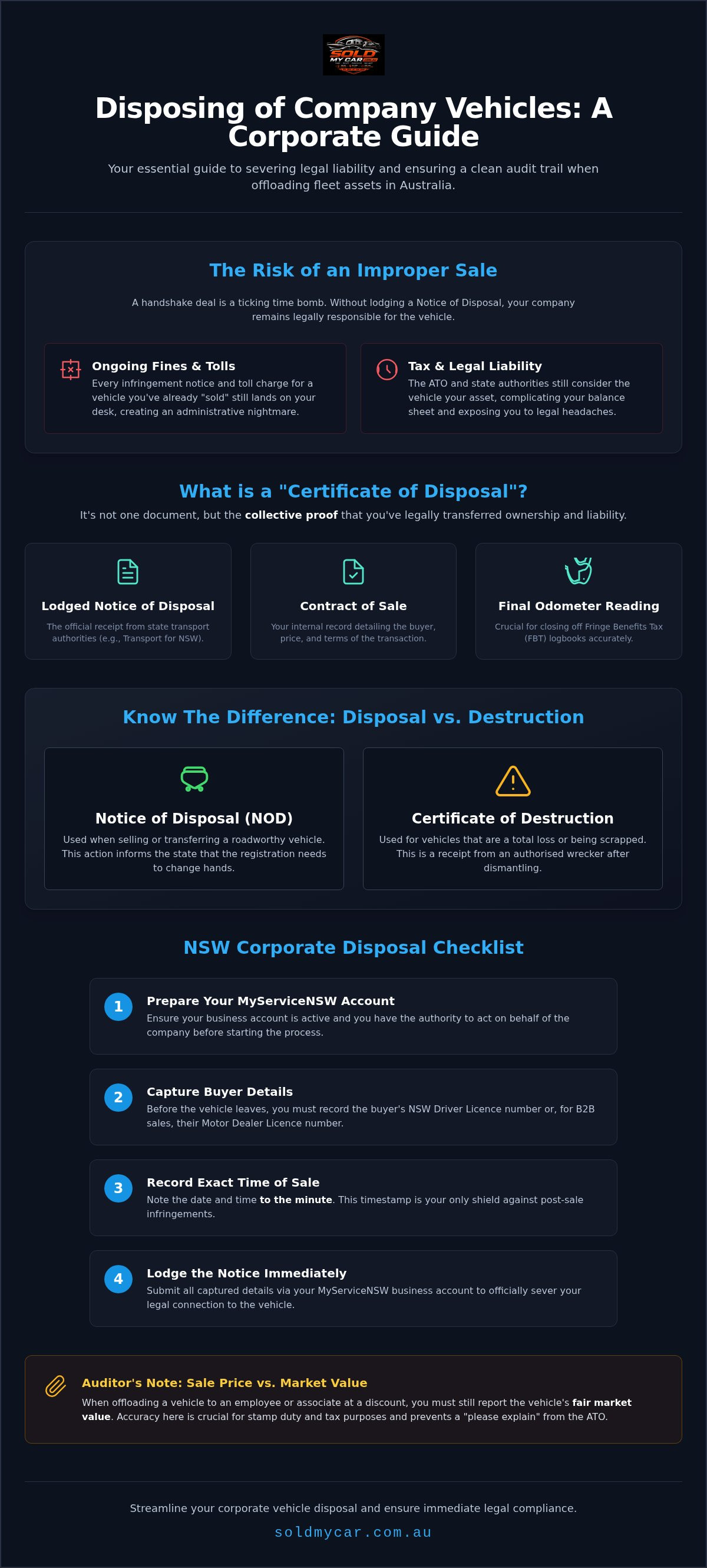
Think of a certificate of disposal for company vehicles as your legal "clean break" from a fleet asset. It isn't always a single, fancy document with a gold seal. Instead, it's the collective proof that your business has officially and legally handed over the keys, the title, and the liability to someone else. In New South Wales, this typically takes the form of a lodged Notice of Disposal (NOD) receipt from Transport for NSW. Without this record, as far as the government is concerned, that vehicle still belongs to your company. If it's caught speeding or parked illegally five minutes after the sale, the fine lands on your desk.
Beyond the immediate legal protection, this record is a non-negotiable for your "books." The Australian Taxation Office (ATO) requires a clear audit trail to justify why a depreciating asset has suddenly vanished from your balance sheet. When your accountant performs a balancing adjustment at the end of the financial year, they need to see exactly when the vehicle left your control. A proper certificate of disposal for company vehicles provides that timestamp, ensuring you don't keep paying for an asset you no longer own.
Why Your Business Needs One Immediately
Liability doesn't end just because you've been paid. You remain responsible for the "rego" until the paperwork is processed. If the new owner skips a toll or hits a red light camera, the infringement notice is sent to your business address. You then have the administrative nightmare of nominating another driver to clear the company's name. It's a waste of time you don't have.
- Insurance: Most insurers won't cancel a policy or refund a premium without proof of sale. This document is your evidence.
- Brand Protection: If your company logo is still on the door, you don't want that vehicle involved in an incident. A lodged NOD proves you weren't the operator.
- Fines: Stop the flow of automated traffic infringements instantly.
Notice of Disposal vs. Certificate of Destruction
Confusion often arises between these two terms. A Notice of Disposal is what you use when selling or gifting a vehicle that's still fit for the road. It tells the state that the registration has changed hands. However, if the vehicle is a total loss or is being scrapped, the process changes. You might deal with the vehicle dismantling industry, where a car is broken down for parts. In this case, you receive a Certificate of Destruction or a similar receipt from an authorised wrecker.
Regardless of the method, your internal records must be robust. A government receipt is great, but your accountant will also want the contract of sale and the final odometer reading. This ensures your Fringe Benefits Tax (FBT) logbooks are closed off correctly, leaving no room for "grey areas" during a potential audit.
Lodging a Notice of Disposal in NSW: A Corporate Checklist
Selling a company car isn't as simple as swapping keys for cash. For a business, the paper trail is everything. To officially secure a certificate of disposal for company vehicles, you must notify Transport for NSW immediately. This process starts with your MyServiceNSW business account. Ensure your login details are active and that you have the authority to act on behalf of the company before you sit down to do the paperwork. It saves a lot of swearing later.
Before the buyer drives off, you need to capture specific data points. Don't let them leave without providing their NSW Driver Licence number or, if you're dealing with a professional, their Motor Dealer Licence number. You also need to Lodge a Notice of Disposal with the exact date and time of the handover. Recording the time to the minute is vital. If the new owner gets a speeding ticket ten minutes after leaving your yard, that timestamp is your only shield.
Reporting the "Sale Price" versus the "Market Value" is another area where businesses trip up. If you're offloading a vehicle to an employee or an associate at a discount, you still need to record the fair market value for stamp duty and tax purposes. Accuracy here prevents a "please explain" from the state revenue office or the ATO later on. This documentation is a core part of your certificate of disposal for company vehicles records.
Requirements for Sydney-Based Fleet Managers
When you're managing a larger fleet in Sydney, you're often dealing with professional buyers. If you choose a specialist for your fleet and corporate vehicle disposal, the process is much faster. You'll use their Motor Dealer Licence number instead of a personal licence. Always verify the buyer's registered business name via the ABN Lookup before finalising the deal. It ensures the entity on your paperwork actually exists and matches your records.
Common Pitfalls When Selling Company Cars
The biggest headache is the 14-day deadline. If you miss this window, you risk late fees and, more importantly, you remain legally liable for the car. Many fleet managers rely on the buyer to "sort the rego," but that's a mistake. The buyer's delay becomes your liability. If the online portal rejects your details, perhaps because of an interstate buyer or a complex business structure, don't just give up. Switch to the paper-based TfNSW Form 1011. It's slower, but it gets the job done when the digital system throws a tantrum.
Internal Records and Auditing: Your Disposal Trail
The ATO isn't known for its sense of humour. When a vehicle leaves your fleet, they expect a clear reason why the depreciation has stopped. A lodged Notice of Disposal is a start. However, for a full audit, you need a complete certificate of disposal for company vehicles record. This means keeping a dedicated "Disposal Folder" for every asset. It should house your NOD receipt, the bill of sale, and proof that the money actually hit your business account. Don't let these documents float around in an inbox. Centralise them immediately.
If you're selling a vehicle that has been involved in an accident, the documentation gets even more specific. You must clarify if the car was a statutory or a repairable write-off. This distinction changes how the asset is handled on your books. It also dictates what you can legally claim as a loss. Getting this wrong can lead to messy "please explain" letters from tax authorities. It's better to get the status in writing from the insurer or the buyer at the point of sale. This protects your business from future disputes.
Managing FBT and Depreciation
Fringe Benefits Tax is a minefield for fleet managers. You must record the final odometer reading the moment the vehicle is handed over. This closes the logbook and ensures your final FBT return is accurate. Without it, you're guessing. The ATO hates guesses. You also need to calculate the balancing adjustment. This is the difference between the sale price and the written-down value of the car. Using an instant car valuation Sydney tool provides a solid market benchmark. It proves you sold the car for a fair price. This is especially important for prestige or classic company vehicles that might trigger Capital Gains Tax questions during a review.
Creating a Bulletproof Audit Trail
Stop relying on handshake deals. They are a nightmare for corporate compliance and a gift for auditors. Standardise your Bill of Sale across the whole fleet. Every document should look the same. It should contain the same vital info. Store everything digitally. A physical receipt from Service NSW is easily lost in a glovebox. Scan it. Save it to the cloud. Link it to your accounting software immediately. This creates an unbreakable link between the physical disposal and your financial reporting. If an auditor knocks on your door in three years, you should be able to pull up the entire history of that ute in three clicks. Speed and accuracy are your best friends here.
Disposing of Salvage and End-of-Life Fleet Vehicles
Not every fleet car makes it to the end of its lease in showroom condition. Some vehicles end up as total losses due to accidents or mechanical failure. When this happens, your certificate of disposal for company vehicles must reflect that the asset is permanently off the road. It's a different beast than a standard sale. You aren't just transferring ownership; you're ending the vehicle's life cycle. Ensuring this is documented correctly prevents your business from being linked to a car that no longer exists.
The first step is identifying the type of write-off. A statutory write-off is the end of the line. These vehicles are only good for parts or scrap. A repairable write-off, however, can theoretically be fixed and re-registered after a massive amount of red tape and inspection. You must report this status accurately to Transport for NSW. Even if a car is crushed into a metal cube, you still have a legal obligation to notify the authorities. Don't assume the scrap yard will do it for you. For bulk salvage projects, consult our guide on cash for scrap cars to see how we handle the heavy lifting.
When You Need a Certificate of Destruction
A Certificate of Destruction is a commercial record issued by a licensed facility. It's your proof that the car was disposed of following environmental standards. This document is vital for protecting your company from "zombie" vehicles. These are wrecks that should have been scrapped but were illegally patched up and sold. If that car is involved in a crime later, your Certificate of Destruction is the only thing proving you didn't own a death trap. It confirms the VIN is dead and buried.
Handling Non-Runners and Fleet Wrecks
Moving non-functional vehicles is a logistical pain. They take up valuable yard space and look terrible to visiting clients. The quickest fix is to get them towed by a professional. Before the truck arrives, pull the number plates. Surrender them to Service NSW immediately. This is a critical step to stop ongoing registration charges and insurance premiums. Professional salvage buyers provide much better documentation than backyard wreckers. They understand the corporate need for a clean audit trail. If you have a wreck sitting in the way, you can sell your salvage car to us and clear the site in 24 hours.
Streamlining Corporate Vehicle Disposal with Sell My Car
Managing a fleet is a full-time grind. You don't need the added stress of chasing private buyers or worrying about whether a Notice of Disposal was actually processed. We handle the heavy lifting. By acting as a licensed motor dealer, we provide a direct B2B transaction that cuts out the middleman. This is the fastest way to secure a certificate of disposal for company vehicles and ensure your business is legally protected the moment the car leaves the yard.
Liability transfer is immediate. Once the deal is done, the paperwork becomes our problem, not yours. If you're offloading twenty units or just one prestige ute, our process remains the same. We offer a professional valuation that gives your internal auditors a clear market-value benchmark. No guesswork. No "mate's rates" that trigger ATO red flags. Just a fair price and a clean break from the asset.
Why Sydney Businesses Prefer Licensed Dealers
Private listings are a total circus. You get "tyre-kickers" who waste your afternoon and low-ballers who don't understand corporate value. We skip the drama. Our service is built for speed and reliability. We provide our Motor Dealer Licence number upfront, allowing for instant online lodgement of your NOD. Payment is guaranteed and secure. The funds are transferred before we take the keys. It's a no-nonsense approach that respects your time and your bottom line.
- Zero viewings: No strangers wandering around your place of business.
- Instant lodgement: Use our dealer details to clear your liability in seconds.
- Bulk efficiency: Move multiple units in a single transaction.
How We Handle Your Paperwork
Our mobile inspection team comes directly to your Sydney office or depot. We assess the fleet on-site, so you don't have to coordinate logistics for multiple vehicles. This is especially useful for bulk disposals where moving stock is a nightmare. After the assessment, we provide comprehensive receipts. These documents are exactly what your accountant needs to close the books and maintain a perfect certificate of disposal for company vehicles file.
We ensure every detail, from the final odometer reading to the tax invoice, is handled with total competence. This leaves you with a clean audit trail and zero lingering liability. For those managing high-end assets, read more about our prestige fleet vehicle disposal Sydney strategy. We provide the professional exit strategy your business deserves, making the entire process fast, fair, and transparent.
Take Control of Your Fleet Exit Strategy
Managing a fleet isn't just about the drive; it's about the exit. You've seen how a single missing form can lead to years of liability and ATO headaches. Securing a certificate of disposal for company vehicles is your final step in a professional handover. It stops the fines, satisfies the auditors, and gives you a clean break from the asset. Don't leave your business exposed by relying on the buyer to handle the "rego" or by keeping messy internal records. It's too much of a gamble.
We make the process simple. As a proud Member of Cox Automotive Australia and a Licensed NSW Motor Dealer, we handle the administrative burden for you. You get same-day payment and the peace of mind that all paperwork is sorted correctly the first time. No tyre-kickers. No delays. Just a fast, professional transaction that lets you get back to running your business. We've seen every scenario and we're ready to help you clear your yard without the stress.
Get an instant offer for your company vehicle fleet today and move forward with total confidence.
Frequently Asked Questions
Is a Notice of Disposal the same as a Certificate of Disposal?
Functionally, yes. A Notice of Disposal (NOD) is the official government term used by state transport authorities like Transport for NSW. A "Certificate of Disposal" is the term often used by corporate auditors and accountants to describe the set of records, including the NOD receipt, that proves a vehicle has been legally removed from the company fleet. Both serve as your primary evidence of a clean legal break.
How long do I have to submit a Notice of Disposal for a company car in NSW?
You must submit the Notice of Disposal immediately after the sale. While the buyer has 14 days to complete the transfer on their end, your business remains liable for every fine and toll until your part is lodged. Don't wait. Submit the paperwork the minute the buyer drives away to stop automated infringements from hitting your desk.
Can I lodge a Notice of Disposal if I don’t have the buyer’s licence number?
No, you cannot complete the online lodgement without the buyer's NSW Driver Licence or Motor Dealer Licence number. If you fail to get these details, you'll be forced to visit a Service NSW centre in person or post a paper form. This is a massive waste of time. Always snap a photo of the buyer's licence before handing over the keys.
What happens if I forget to lodge the Notice of Disposal?
You stay legally responsible for the vehicle as the registered operator. If the new owner speeds, parks illegally, or skips tolls, the fines are sent to your company address. You then have the administrative burden of nominating the actual driver to clear the company's name. It's a avoidable headache that can drag on for months if the buyer is uncooperative.
Do I need to provide a roadworthy certificate when selling a company vehicle to a dealer?
No, you generally don't need a pink slip or roadworthy certificate when selling to a licensed motor dealer. Dealers buy vehicles in "as-is" condition, which saves your business the cost and time of pre-sale repairs. This is a major reason why fleet managers prefer dealer transactions over private sales. It simplifies the certificate of disposal for company vehicles process significantly.
How does selling a company car affect my Fringe Benefits Tax (FBT)?
Selling the car ends the FBT period for that specific asset. You must record the final odometer reading on the exact day of disposal to close off your logbook records. This ensures your final FBT return is accurate and prevents the company from paying tax on a benefit that is no longer being provided to an employee.
Can I sell a company vehicle that still has finance remaining?
Yes, but the encumbrance must be cleared during the transaction. A professional buyer will typically contact your finance provider to get a payout figure. They then pay the lender directly and transfer any remaining balance to your company account. This ensures the vehicle has a clear title, which is a legal requirement for a valid transfer of ownership.
What is a Certificate of Destruction and when does my business need one?
A Certificate of Destruction is a commercial record issued by a licensed wrecker when a vehicle is scrapped or recycled. You need this if a fleet car is a statutory write-off and can never return to the road. It proves your company disposed of the asset through an authorised facility that meets environmental standards, completing your internal audit trail.


